

 Print
Print Send Link
Designing for palpability: Workshop at Pervasive 2007
This site contains information about the workshop Designing for palpability at the forthcoming Pervasive 2007 conference, May 13-17 in Toronto, Canada.
Contact: designing4palpability(at)ist-palcom.org
Call for participation
Pervasive computing has taken computing beyond comprehensive systems into a multitude of devices and environments. In some sense this makes the computer disappear (Weiser 1991) and it enables ‘bricolage' of disparate elements. However, people find it hard to realise the potential of pervasive computing. Which devices, services or resources are the best ones to use in a given situation? How to address breakdown? What to do when surrounded by potentially thousands of services and devices one could use? What when safety or privacy matters? To engage pervasive computing technologies effectively and creatively, people need to be able to notice and make sense of actual and potential computational processes, states, affordances and dependencies. They need to be able to do so in ways that are appropriate for their specific situation, their level of computer ‘literacy' and interest.
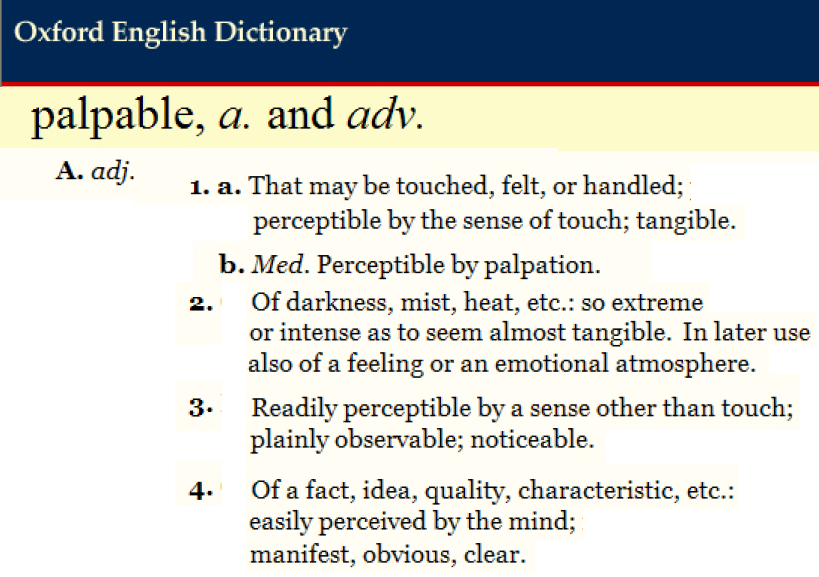
For us, an important element of what is needed is captured by the word ‘palpable', especially in its meaning of 'plainly observable', 'noticeable, 'manifest, obvious, clear' (Oxford English Dictionary). Palpability is not a property of the technology itself, but an effect of people's engagement with technologies, objects, and environments. For designers of pervasive computing, this means that they cannot design palpability into technologies. But they can design for palpability, to support people in making computing palpable. Doing so challenges a number of concepts introduced with the vision for pervasive computing. For example, 'invisibility', 'ambient intelligence', 'autonomy' and '(de-)composition' - turn out to require respecification with regard to people's practices of using technologies at work, and in everyday life and play. Notions like inspection, experimentation, translation, emergent use, etc. become important.
For this workshop we invite 3-5 page position/design example papers that explore how one might design for ‘palpability'. Our own approach is informed through ethnographic studies and participatory design and focuses on the development of architectural support and a vision for ‘palpable' pervasive computing. Questions contributors might wish to address include:
- How do people make things 'palpable' for themselves and others? E.g. fieldstudies of human-computer interaction, but also practices within the sciences, medicine, the arts or any other relevant area of human practice. Theoretical or philosophical submissions are also welcome.
- What technical possibilities exist? E.g. reviews and reports of existing approaches, for example, computational reflection, accountability, seamful design, design for dependability, palpable computing
- What are the experiences with existing technical approaches?
- How can we understand, and create new resonances, between human and machine, actual and potential, behaviour?
- Which design methods are best suited to addressing the challenges? E.g. reports and reflections on methodological innovations, or new challenges for traditional methods
The aim of this workshop is to bring together experts from different disciplines and approaches to develop the state-of-the-art in this emerging field of research and design. We may pursue opportunities to publish a special issue journal edition. Participation is limited to 30 participants. Position papers will be circulated beforehand. It is possible to participate without submitting a paper.
Organisers
Peter Andersen, Mads Ingstrup, Morten Kyng, Preben Mogensen,
Computer Science Department, Aarhus University, Denmark
Monika Büscher, Dan Shapiro,
Department of Sociology, Lancaster University, UK
Christian Heath, King's College, London, UK
Background
The proposers have a long-standing involvement in socio-technical innovation and participate in the Palpable Computing project (PalCom: A new perspective on ambient computing, www.ist-palcom.org ), which brings together European research teams to create an open architecture, application prototypes, and a vision for, palpable computing through ethnographically informed and participatory design. The PalCom initiative envisages pervasive computing technologies whose states, processes and affordances can be made ‘palpable', and are therefore more effectively understood, appropriated and controlled.
Important Dates
February 16 |
Deadline for Submissions (3-5 pages) |
|
March 2 |
Notification of accepted Proposals, registration for the workshop |
|
May 13 |
Start of Pervasive 2007, Palpable Computing Workshop |
|
May 14-16 |
Pervasive 2007 conference, Paper Programme and Tutorials |
|
|
||
Agenda
March 2- May 13 Exchange of papers.
Participants are encouraged to read all papers before the workshop.Sunday, May 13, Pervasive 2007
09:00 – 09:30
Coffee and light pastries / Introduction and plan for the day
09:30 – 10:30
Presentations (15 minutes each)
Büscher M Studies of intra-action: Informing design for palpability
Ingstrup M, Wolff Olsen, J Inspecting Abstractions as a Means to Palpability of Programs
Tollmar K, Enquist H, Corry A, Interaction Ecologies
10:30 – 10:45
Coffee
10:45 – 12:00
Presentations (15 minutes each)
Voss A, Procter R, Hartswood M, Rouncefield M, Slack R Designing for Palpability in e-Research
Betz M, Huq M, Pipek V, Rohde M, Stevens G, Wulf V Architecture for Adaptable Component Based Systems: End User Driven Real Life Tagging for Individualized Context-Awareness
Huq, M. EUDCASys: a Proposal to Introduce End User Developable Context Aware System.
Ghizzioli R, Rimassa G, Greenwood D A Seamless Hybrid Communication System forTransient Locations
Ingstrup M, Dourish, P. What are we Interacting With? : Architectural Reflection for Technical Translucence in Ubiquitous Computing
12:00 – 13:00
Lunch in the Atrium outside the rooms all Workshops together
13:00 – 14:00
Presentations (15 minutes each)
Kyng, M. and Kristensen, M. Supporting Palpability in Emergency Response
Corry A, Aaløkke S, Kramp G, Balancing user control
Marti P, Grönvall E, Pollini A, Rullo A, Supporting inspection strategies through palpable assemblies.
14:00 – 15:00
Group discussions
15:00 – 15:30
Coffee
15:30 – 16:30
Group discussions, making posters
16:30 – 17:00
Plenary discussion: Where do we go from here?
19:00
Joint Dinner
Contributions
Betz M, Huq M, Pipek V, Rohde M, Stevens G, Wulf V Faculty of Information System and New Media, University of Siegen, Siegen, Germany. {matthias.betz | syed-m.huq | volkmar.pipek | markus.rohde | gunnar.stevens | volker.wulf @uni-siegen.de}
Architecture for Adaptable Component Based Mobile Systems: End User Driven Real Life Tagging for Individualized Context-Awareness
Abstract: Palpable computing paradigm aims to support user control by composing and decomposing assemblies of devices and services, which communicate and exchange data. As a product of a research project, conducted by University of Siegen and Fraunhofer Institute of Applied Information System, we have developed Context-Aware Adaptable System (CAAS) architecture. This architecture has both adaptive and adaptable nature. In this research paper, we would like to describe the addition of RFID technology in a prototype based on CAAS architecture. Through the RFID technology users of the prototype will be able to define contexts of use by using small RFAID tags..
________________________________________________________________________
Büscher M Department of Sociology, Lancaster University, UK, m.buscher@lancaster.ac.uk
Studies of intra-action: Informing design for palpability
Abstract: Starting out with a concrete example of some of the problems people encounter in realizing the potential of pervasive comput-ing, I present a detail from ethnographic observations in a neonatal intensive care unit to explore important causes for these difficulties in depth. Inspired by, but also critical of, notions of interactive and accountable computing, I propose to use studies of human-matter ‘intra-action’ to inform design for palpability.
________________________________________________________________________
Corry A, Aaløkke S, DAIMI, University of Aarhus, Denmark, apaipi@daimi.au.dk, stinne@daimi.au.dk
Kramp G, Aarhus school of Architecture, Denmark, gkramp@daimi.au.dk
Balancing user control
Abstract: Often elderly people experience problems when introduced to assisted living technologies in their homes, as many of these technologies are based on principles of automation and invisibility. This paper reports on field studies of assisted living technology in the homes of seven elderly people. Based on the fieldwork and issues related to palpable computing we argue that when designing for assisted living a balance must be found, between ambient technology and palpability. Potentially making the technology noticeable, understandable and controllable depending on the situation of the elder.
________________________________________________________________________
Ghizzioli R, Rimassa G, Greenwood D, Whitestein Technologies AG, Switzerland.
frgh,gri,dgrg@whitestein.com, www.whitestein.com
A Seamless Hybrid Communication System forTransient Locations
Abstract: This paper presents the RASCAL System, a middleware component able to palpably ensure that user-level services communicating across infrastructure or ad-hoc networks continue to work even when deployed in disruptive environments such as major incidents sites. By palpable we mean that users should be able to notice, comprehend communication actions and - where necessary - negotiate di®erent levels of user control. This work highlights the features of the system, the end-user interaction and an evaluation scenario.
________________________________________________________________________
Huq, M. Faculty of Information System and New Media, University of Siegen, Siegen, Germany. syed-m.huq@uni-siegen.de
EUDCASys: a Proposal to Introduce End User Developable Context Aware System.
Abstract: Context Awareness (CA) is an important capability needed in devices in a ubiquitous computing environment. Ubiquitous computing devices use different types of sensors along with the user's interaction histories to collect and store data. This data is then used to adapt the user's behavior to suit the current environment. End User Development (EUD) capability is an essential part of any flexible ubiquitous computing system. When EUD based systems are well designed they allow users to add functionalities that were not, and in many cases, could not have been anticipated by the system's designers. This enables users to benefit fully the possibilities ubiquitous computing offers. In this research paper the author would like to propose a system that is context aware on one hand and end user developable on the other – End User Developable Context Aware System (EUDCASys). The proposed EUDCASys will be both adaptive and adaptable in nature.
________________________________________________________________________
Ingstrup M, Department of Computer Science, University of Aarhus, Denmark. ingstrup@daimi.au.dk
Inspecting Abstractions as a Means to Palpability of Programs
Abstract: Palpability comprises both mental and physical apprehensibility. We describe how reflection can be used enable programs to be self-documenting. We describe how programs are made of abstractions, how such abstractions can be inspected and how they can be meaningful and not-too-complex to users. We exemplify our approach using the architectural concept of a connector.
________________________________________________________________________
Ingstrup M, Department of Computer Science, University of Aarhus, Denmark. ingstrup@daimi.au.dk
Dourish, P. University of California, Irvine, USA, jpd@ics.uci.edu
What are we Interacting With? : Architectural Reflection for Technical Translucence in Ubiquitous Computing
Abstract. A number of researchers have observed that ubiquitous applications pose new challenges to usability because their locus of interaction has moved away from the traditional computer desktop and been distributed through the everyday world. We argue that the distributed nature of ubicomp infrastructure also poses interaction challenges. Ubicomp systems are made up of collections of components only some of which the user may have access to or be able to control. We propose a solution to this problem based on architectural reflection, essentially making aspects of a system's architecture visible in its interaction model, an approach we label “technical translucence.” We present a case study in which architectural reflection is used to give insight into and control over privacy in a distributed, location-based system.
________________________________________________________________________
Kyng, M. and Kristensen, M. Department of Computer Science, University of Aarhus, Denmark. mkyng@daimi.au.dk, margit@daimi.au.dk
Supporting Palpability in Emergency Response
Abstract. This paper investigates how to design ICT support for emergency response. We conceptualize the incident site with people, vehicles, buildings etc. as boundary objects over which complex and imperfect work of coordination is done – and discuss how a 3D representation of these entities may be used as a way of bridging between the physical entities and the body of digital information about the site and the different entities, accumulating as the incident unfolds.
________________________________________________________________________
Marti P, Grönvall E, Pollini A, Rullo A, University of Siena, Communication Science Department, Italy.
marti@unisi.it, {gronvall, pollini, rullo}@media.unisi.it
Supporting inspection strategies through palpable assemblies.
Abstract: The paper reports an early study on inspection strategies of high-risk systems using ambient computing technologies. Traditionally, the main goal of ambient, pervasive and ubiquitous computing applications is to make the technology transparent or invisible for the users. However this sort of technological disappearance is not always desirable in particular in presence of any failure in the system. In such an event the user would benefit from the visibility of the system state, and from adopting inspection strategies to detect the error and take, if possible, the necessary correctional measures. The paper presents a study performed in a Neonatal Intensive Care Unit where novel ambient computing technologies and related inspection strategies are currently being designed and assessed in the context of the European project PalCom (http://www.ist-palcom.org/).
________________________________________________________________________
Tollmar K, Enquist H, Department of Informatics
Lund University, Sweden. Konrad.Tollmar[at]ics.lu.se
Corry A, DAIMI, University of Aarhus, Denmark, apaipi@daimi.au.dk
Interaction Ecologies
Abstract: In this paper we present one approach to understand palpability from the perspective of eco-systems of palpable devices and services. We will introduce the notion of Palpable Interaction Ecology that focuses in particular upon the properties that emerge from the interaction between people, their practices and palpable devices and services.
________________________________________________________________________
Voss A, Procter R, National Centre for e-Social Science, University of Manchester, United Kingdom, alex.voss | rob.procter@ncess.ac.uk
Hartswood M, School of Informatics, University of Edinburgh, United Kingdom, mjh@inf.ed.ac.uk
Rouncefield M, Department of Sociology, Lancaster University, United Kingdom, m.rouncefield@lancaster.ac.uk
Slack R, School of Social Science, University of Wales at Bangor, United Kingdom, roger.slack@bangor.ac.uk
Designing for Palpability in e-Research
Abstract: The vision of e-Research and of grid technologies is one of seamless, virtual and constantly changing resource usage where users need not concern themselves with details, such as exactly where an application is running or where their data is being stored. As with previous technologies, there is an ambition to make it become ‘invisible’, to hide details of
its working or even its very existence from the view of the user. However, seamlessness and virtualisation often imply a lack of control that users may be wary of or even opposed to. We look at scientific workflows as an example of how people may configure various heterogeneous and independent resources to serve their aims and support the activities they are involved in. Drawing out some issues involved in the design and use of scientific workflow systems we argue that there is an overlap between them and concerns that palpable computing seeks to address. We raise the question how work in one area can inform that done in the other and if there might indeed be a common design space that would allow candidate solutions to be traded as well.